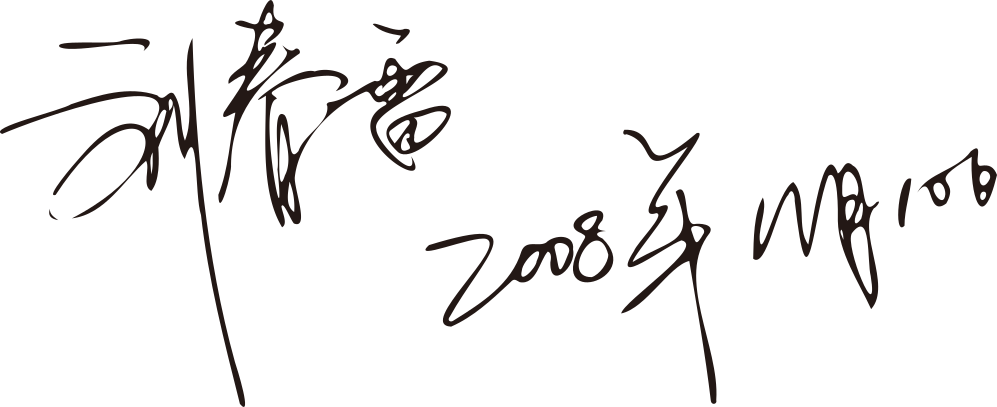
I learned board games at the age of three, starting with Chinese chess before turning to Go. Yet as a self-taught enthusiast, I never entered the professional arena. Then I shifted my path to law and became a lawyer, roaming the world like a chivalrous hero with unyielding integrity.
As the financial crisis first loomed, my ambition remained undimmed. Gathering like-minded legal professionals, I founded Liu Chunlei Law Firm with firm resolve.
Life is like a game of chess; one must strive bravely to succeed.
Chinese chess embodies the spirit of Confucianism, a reflection of “bowing down to learn from the earth”. Its pieces — general, advisors, elephants, chariots, horses, cannons, and soldiers — are clearly divided by a river boundary, each with fixed positions, roles and movement paths. This structure accords with the social order and hierarchical ethics of Confucianism, while the complexity of battle symbolizes the diversity of social conflicts.
Chinese chess values fortitude: all pieces move actively across the board, and greater mobility means greater advantage. Chariots, horses and cannons charge into battle; “a soldier crossing the river never turns back”, echoing the heroic resolve of Jing Ke: “The wind sighs, the Yi River chills; a hero sets forth, never to return.” It inspires perseverance and proactive endeavour.
Litigation and dispute resolution are just like Chinese chess: strategizing carefully, striving courageously, achieving victory with apparent ease so that “no fame for wisdom, no merit for bravery” — a classic ideal.
Go embodies the ethos of Taoism, a crystallization of “looking up to observe the heavens”. With only black and white stones representing yin and yang, the board resembles the sky and the stones the stars. Their alternating placement mirrors the evolution of time and space, the universe unfolding from nothingness to wholeness, from simplicity to complexity.
Go values gentleness, emphasizing non-contention: “He who contends for the game creates no classic game.” “By not contending, no one under heaven can contend with him.” It pursues the ideal of subduing the enemy without fighting. “The great Dao acts through non-action, yet nothing is left undone” — it reflects the wisdom of assessing the moment and adapting to circumstances.
The founding and growth of Chunlei Law Firm mirrors the Taoist principle: “The Dao begets one; one begets two; two beget three; three beget all things.”
The highest good is like water, gathering strength before surging forward. When the essence of Go is fully realized, so too will Liu Chunlei Law Firm flourish.
Just as Confucianism and Taoism complement each other, Chinese chess and Go share profound similarities in principle.
Opening play demands a holistic vision — “the entire game as one”.
Mid-game battle requires precise calculation — “one careless move loses the whole game”.
The supreme state is peaceful reconciliation. The philosophy of “harmony is precious” speaks precisely to our harmonious society today. Only through harmony can win-win outcomes and common development truly be achieved.
Mastering the principles of the game and competing wisely is the foundation of standing firm and achieving victory.With a steady mind, we handle cases with unwavering resolve;with an ordinary heart, we pursue our cause with dedication.